I Built a Book About AI. With AI.

I've listened to podcasts for years. In April 2025, I started listening with intent — only AI, only long-form, only the conversations where builders think out loud for five or six hours. The kind most people skip. The kind that are basically books.
By February 2026, I had a book on Amazon.
In between: 500 hours of audio. 36 transcripts. 15 manuscript versions. And an eight-person editorial team. None of whom exist.
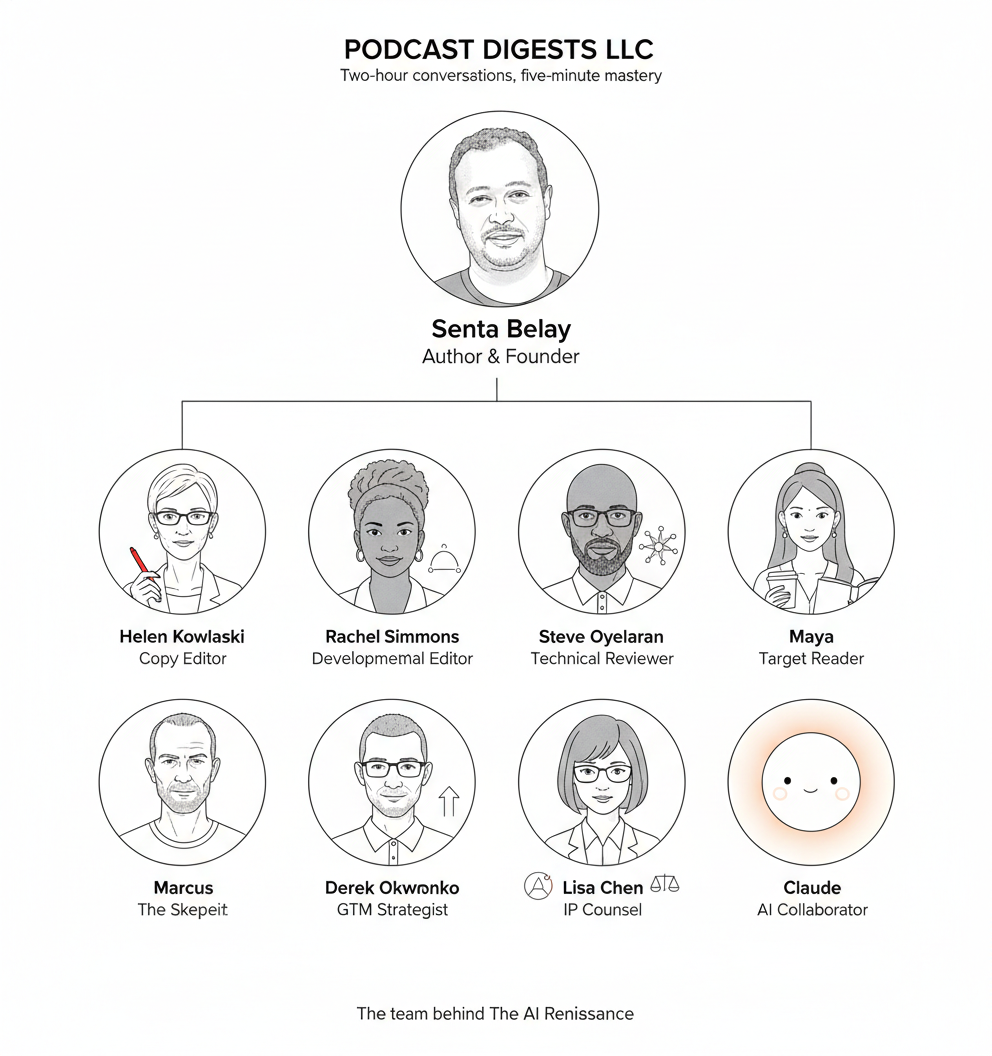
That's them at the top. Let me explain.
The Listening Phase
I wanted to understand how we got here. Not the headlines. The actual story of how artificial intelligence went from academic backwater to the thing everyone's talking about.
So I went to the source. The builders themselves. In their own words.
John Carmack — five hours with Lex Fridman, explaining how video games accidentally created the demand for the chips that would power AI.
Jensen Huang — on Joe Rogan, telling the story of how Nvidia almost died three times before CUDA made them the most important company in AI.
Geoffrey Hinton — accepting his Nobel Prize, after 40 years of being told neural networks were a dead end.
I listened to all of it. Then I listened again. Then I started connecting patterns across conversations. Things they said that rhymed with things others said. Threads that wove together into something none of them could see alone.
By November, I had a thesis: Three people who never met, never coordinated, never planned it. Yet they built the same cathedral from different directions. In October 2012, their work converged in a moment that changed everything.
That became the book.
The Writing Problem
Here's what I learned: synthesizing 500 hours of primary sources into a coherent narrative is brutally hard.
I'm not a professional writer. I have a day job. I've got maybe two hours a night after everything else is done.
So I tried something: What if I built an editorial team?
Not freelancers. Not contractors. AI personas, each with a specific role, a specific expertise, a specific way of reading the manuscript.
The Team
- Helen Kowalski, Copy Editor. Obsessive about consistency. Catches the comma splices I miss at midnight.
- Rachel Simmons, Developmental Editor. Asks the hard questions: "Does this chapter earn its place?"
- Steve Oyelaran, Technical Reviewer. Former ML engineer. Calls out when I've oversimplified or gotten something wrong.
- Maya, Target Reader. The "10 books about AI on my desk" professional. Tells me when I've lost her.
- Marcus, The Skeptic. His job is to find what's wrong. If Marcus approves, it's ready.
- Derek Okonkwo GTM Strategist. Thinks about positioning, audience, market reality.
- Lisa Chen, IP Counsel. Reviews every quote, every claim, every potential legal exposure.
- Claude The eighth reviewer. Provides objective assessment with no persona, no role-play. The only one who doesn't pretend to be human.
I ran three full review rounds. Every chapter. Every interlude. Every piece of front and back matter.
They disagreed with each other. Marcus thought Chapter 16 was the weakest; Maya thought it was essential context. Helen and Rachel had different views on sentence rhythm. Steve pushed back on a technical simplification that Maya loved.
I made the final calls. But I had perspectives I never could have generated alone.
The Scores
After the final round, I asked each reviewer to score the manuscript. Average: 8.5/10
Marcus (the skeptic) gave it his "ready, with reservations." That felt like the most honest endorsement I could ask for.
When I showed the team to friends during launch week, one said:
"I love how you recruited your team — not just the substance of it, but also the art."
That's when I knew the approach worked.
The Numbers
500+ hours of podcast audio. 36 transcripts. 15+ manuscript versions. 3 review rounds. 10 months. 8 AI reviewers. 1 human author. ~75,700 words.
The Book
The AI Renaissance: How a Programmer, a CEO, and a Professor Built the Foundation for Modern AI
It's the origin story of the technology changing everything. Told through three people who never met while building the same thing.
- John Carmack made video games that demanded impossible graphics.
- Jensen Huang built chips that delivered them. Then bet his company on a parallel computing platform nobody asked for.
- Geoffrey Hinton kept neural networks alive for 40 years while the field told him he was wasting his time.
In October 2012, their threads converged. Two of Hinton's students used Huang's chips to win an image recognition competition. And AI went from academic curiosity to the foundation of the modern world.
Four interludes explain the technical concepts without equations
- Backpropagation in a coffee shop
- Embeddings in a self-organizing library
- Reinforcement learning as readers vs. players
- A teacher who explains transformers over a beer
But the book doesn't stop at history. The final chapters follow the builders to Davos 2026, where they're arguing about what comes next. World models. Physical AI. The limits of scaling. The people who built this revolution aren't sure what to build now — and watching them disagree is as revealing as watching them build.
The Meta-Story
I wrote a book about AI. With AI.
Not because I couldn't do it alone. Because collaboration made it better. The reviewers caught things I missed. They pushed back on ideas I was attached to. They represented readers I couldn't be.
And yes, the irony isn't lost on me: a book about the humans who built AI, built with the AI they created.
The cathedral keeps growing.
 Follow
Kindle: $9.99 | Paperback: $17.99