I Wrote a Book About AI. Then I Let AI Read It Back to Me.

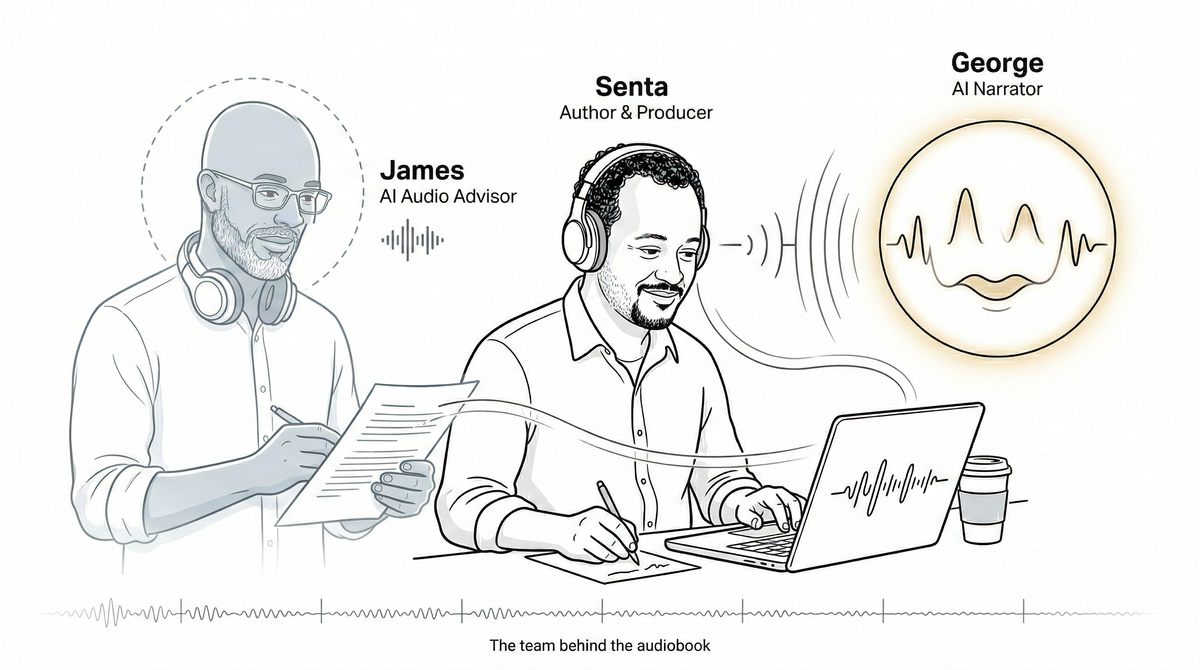
I spent a year listening to podcasts about AI. Then I wrote a book about it. Then I wanted to hear it read back to me.
That last part is where it got interesting.
The Thesis
Here is what I wanted to prove: you do not need permission to publish an audiobook.
The traditional path goes like this. You finish your manuscript. You search for a narrator. You audition voices. You negotiate rates. You wait for availability. You coordinate schedules. You work with a producer. You wait some more. Lead time, dependency, gatekeepers at every step.
I wrote The AI Renaissance in part about this exact problem. The history of technology is a history of removing bottlenecks. Gutenberg removed the scribe. The internet removed the distributor. AI is removing the last ones: the specialists you used to need between your idea and its final form.
So I decided to test the thesis on my own book.
Finding George
I will be honest. I wrote 75,000 words about artificial intelligence, about neural networks and transformers and the people who built them, and I still did not fully understand how a voice prediction machine works. Not at the level I understood text generation or image synthesis, which I covered extensively in the book.
Voice was new territory. I was an AI tool user discovering a new tool, the same way millions of people are discovering these capabilities right now. Curiosity came first. Understanding came after.
I tested two voices. Alice was clear and precise. An educator's voice. George was warmer. A storyteller's voice. For eight hours of narrative nonfiction, the kind where you follow three people across decades, warmth wins. George it was.
Then I found Brian. Deep, resonant, comfortable. If you have ever used Audible, you know the voice that says "This is Audible." Brian has that energy. I used him sparingly, just a few interludes where the story needs a clear break. When Brian comes in, you know something is shifting. George tells the story. Brian marks the turns.
The Real Work
Here is what nobody tells you about AI narration: the machine is good enough to fool you into thinking it is easy.
It is not easy.
George reads beautifully. His pacing is natural. His emphasis is surprisingly human. But he has blind spots. And the biggest one, for a book about artificial intelligence, was the term "A.I." itself.
Say it appears at the beginning of a sentence. George reads it one way. In the middle? Different. Right after a period? Different again. Sometimes he nails it. Sometimes he reads it as a word, "ay," or stumbles into something unrecognizable.
In a book where "A.I." appears hundreds of times, the inconsistency is maddening.
So you listen. All eight hours. You mark every stumble. You go back to the text and adjust. Add a period here, remove one there. Swap "A.I." for "artificial intelligence" in some spots. Restructure a sentence so the term lands in a position George handles well.
Then you listen again.
A couple of weekends. Several late nights. You develop a relationship with the patience these tools demand. They are powerful, but they are not finished. You meet them where they are.
James, the Audio Advisor
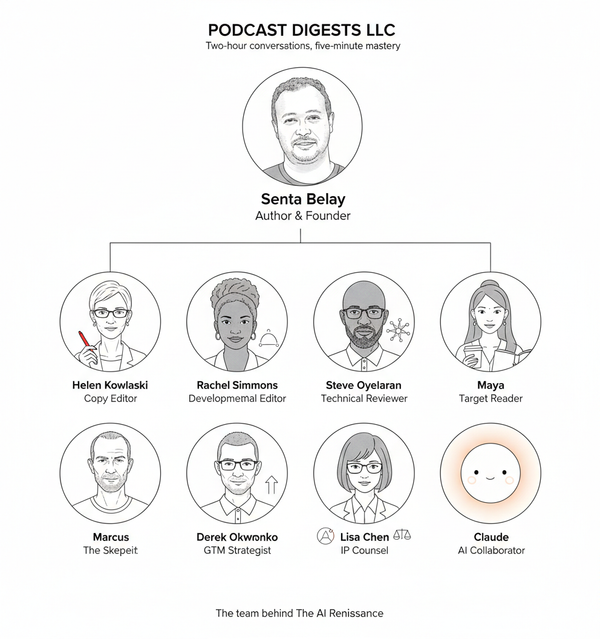
This is the part that still surprises people. My editorial team is AI. All of them. Including James Whitfield, my audio production specialist.
James does not narrate. He advises. His expertise is in what makes text "speakable" versus merely "readable." There is a difference, and it matters enormously in audio. A sentence that flows on the page can be a disaster when spoken aloud. Nested clauses. Pronoun confusion. Tongue-twisters you never noticed because your eyes skipped past them.
When the pronunciation fixes got too numerous to track by hand, I went to James. Bulk changes across 70,000 words. Apostrophes that confused the voice engine. Exclamation marks that made George shout when the text called for quiet emphasis. Spacing adjustments that created the pauses I wanted. Section breaks that told George to breathe.
As James himself puts it: "AI narration is less forgiving of bad prose than human narrators. A human can interpret their way through a confusing sentence. AI will read it literally, and it will sound terrible. If you are considering AI narration, you need better audio preparation, not less."
He was right. The audio-ready manuscript went through three versions before I let George record the final take.
What Changed
The traditional path I described earlier? Two to four months. $1,600 to $3,200 for an eight-hour book. And at every step, you are waiting on someone else.
I did not want to wait on someone else. That was the whole point!
One tool. Two voices. One month of nights and weekends. Total cost: $99 for one month of ElevenLabs Pro. But the real investment was time. Learning how to talk to these tools, how to listen for what they get wrong, how to adjust and try again. Doing is learning. And by the end of it, I understood AI voice synthesis in a way that no tutorial could have taught me.
The audiobook is now live on Spotify, Google Play, ElevenReader, and submitted to Audible. Four platforms, all from a laptop.
What It Means
I am not making the case that AI narration is better than human narration. It is not. A great human narrator brings interpretation, emotion, and instinct that no voice model can match yet.
But I am making the case that good enough, done now, available everywhere, beats perfect that never ships. The choice was never between AI narration and a professional studio. The choice was between doing it myself and waiting for permission. I do not wait well.
The world has changed. Not because a machine can read a book aloud. That part is just engineering. The world has changed because the distance between having an idea and putting it into the world has collapsed to nearly zero.
Write with AI. Edit with AI. Narrate with AI. Publish from your laptop.
The gatekeepers did not step aside. They just became optional.
It is how we embrace these tools that makes the future something of a brave new world. Not the tools themselves, not the hype, not the fear. The willingness to sit with an imperfect machine on a Saturday night, listening to it mispronounce your thesis for the fourteenth time, and fixing it anyway.
That is the work now. And honestly? It is good work.
The AI Renaissance audiobook is free on Spotify with a Premium subscription. Listen here:
https://open.spotify.com/show/5xcVhNoidu461Xlb0r1bTe
Also available on Google Play Books and ElevenReader. Audible coming soon, pending their review.
Senta Belay wrote The AI Renaissance: How a Programmer, a CEO, and a Professor Built the Foundation for Modern AI. Not because he wanted to be an author. Because he wanted to understand something. He writes at the intersection of technology, business, and the human experience of living through the AI transition.